Only 1 in 8 clinical prediction studies shares its code, MIT and Dana-Farber review finds
A team led by MIT and Dana-Farber Cancer Institute used a language model to check almost 4,000 papers. Code sharing was rare, and shared repositories were often hard to rerun. The results will feed into TRIPOD-Code, a new reporting guideline.
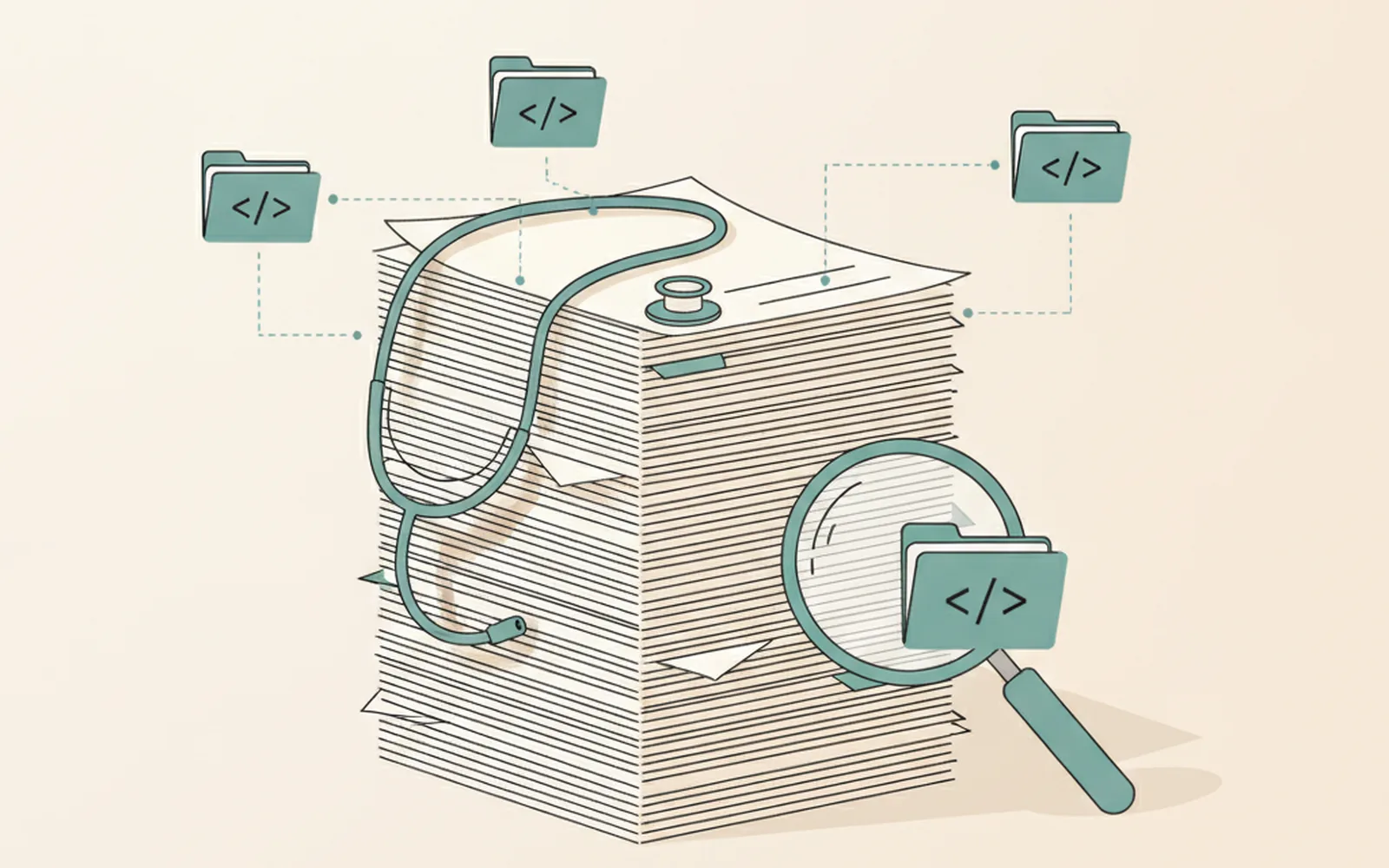
- Of 3,967 clinical prediction model papers, 482 (12.2%) said their code was shared. The analysis appeared in Nature Medicine, and MIT News reported on it on 19 November 2026.
- Shared repositories varied widely in documentation, dependency lists and how easy they were to run. Sharing rates ranged from zero to over 70% between journals.
- Some journals with written code policies still had low sharing rates. The authors say expectations need to go beyond "code is available".
Clinical prediction models estimate a patient's risk of an outcome, such as developing a disease, and they increasingly inform care. A review published open access in Nature Medicine now shows how rarely the code behind these models is shared. Among 3,967 articles that cite the TRIPOD or TRIPOD+AI reporting guidelines, only 482, or 12.2%, included a code-sharing statement.
The study was led by researchers at MIT and Dana-Farber Cancer Institute and was funded mainly by the National Institutes of Health. MIT News covered it on 19 November 2026, after a short research summary from Dana-Farber. The summary is direct: even when code was shared, "it was rarely reproducible".
This matters beyond the paper itself. A prediction model that looks useful in a journal often moves on to validation at another hospital or into a working clinical tool. That work usually goes to a hospital IT team, a research software engineer or outside healthcare software development services, and all of them start from the published repository. If the repository has no documentation or dependency list, they have to rebuild the analysis from the methods section.
What did the study find?
The review found two gaps: code sharing is uncommon, and shared code often lacks what someone else needs to run it. The main findings:
- Uneven repositories. First author Thomas Sounack told MIT News that some repositories were "extremely well-organized and -documented, while others gave almost no guidance at all".
- Large differences between journals. The share of studies with code ranged from zero to more than 70% depending on the journal. Rates also differed by country.
- Policies are not enough. Some journals with low sharing rates had written code-sharing policies.
- Good examples exist. Some authors published synthetic datasets so others could run the code when patient records could not be shared.
The paper also cites earlier work: in a large attempt to rerun Jupyter notebooks linked to biomedical articles in PubMed Central, only 5.3% ran end to end.
How did a language model review 4,000 papers?
The team used a large language model to read unstructured text that a simple keyword search would miss. Sounack said authors "discuss and link to code from a paper in many different ways". The pipeline worked in three steps:
- An LLM screened each paper, found statements about code availability and extracted repository links.
- Software downloaded the linked repositories.
- Each repository was checked against 14 predefined reproducibility-related features, such as documentation, software requirements and terms of reuse.
Two human reviewers independently checked 500 papers and a separate sample of repositories. Agreement with the automated results was stronger for concrete items, such as whether a licence file existed, than for judgments about whether documentation was adequate. For that reason the authors stress overall patterns rather than exact counts.
What is TRIPOD-Code?
TRIPOD-Code is a reporting guideline under development that will define which parts of shared analytical code are essential. It builds on TRIPOD and TRIPOD+AI, the checklists many authors already use to report how a prediction model was built and tested. The team is developing it through an expert review process, and this study is one of its inputs.
Senior author Tom Pollard of MIT's Laboratory for Computational Physiology said the aim is to "give researchers practical guidance on how to share code, and give journals clearer expectations to communicate to authors".
What should authors and journals do now?
The paper names three gaps: documentation, dependency specification and an executable structure. Each one has a simple fix, and you do not need to wait for TRIPOD-Code to make it.
- Write a README that explains how to run the analysis. List the steps from raw data to each figure and table. Our guide to writing a README for research code has a template.
- Pin your dependencies. Add a lock file or a container definition. See reproducible environments for research.
- Add a licence file. Without one, others have no clear permission to reuse the code. Our licence primer explains the options.
- Provide synthetic data when patient data cannot be shared. A small fake dataset with the same columns lets reviewers run the code.
- Write a specific code availability statement. Link to an archived version with a DOI, not just a GitHub page. Our code availability statement guide shows examples.
For editors, the finding about policies is the main lesson: the review suggests that a written policy alone does not make authors share code. Our journal code policy tracker shows which journals require code and which only encourage it.
Questions about the study
What did the Nature Medicine study find?
Of 3,967 clinical prediction model articles that cite the TRIPOD or TRIPOD+AI reporting guidelines, 482 (12.2%) included a statement that code was shared. Where code was shared, repositories varied widely in documentation, dependency information and how easy they were to run.
How did the researchers review almost 4,000 papers?
They built a pipeline in which a large language model screened the papers, found code availability statements and extracted repository links. Software then downloaded the repositories, which were checked against 14 predefined reproducibility-related features. Two human reviewers independently checked 500 papers and a sample of repositories to test the automated results.
What is TRIPOD-Code?
TRIPOD-Code is a reporting guideline under development that will define what researchers should share when they release analytical code for clinical prediction models. It builds on the TRIPOD and TRIPOD+AI checklists, and the new review is one of the inputs to it.
Do journal code policies work?
Not on their own, according to the review. Sharing rates ranged from zero to more than 70 percent across journals, and some journals with written code-sharing policies still had low sharing rates.
Keep reading. More from the desk.
TACC launches Sagebrush: an always-on AI inference service for open science
TACC is building Sagebrush, an NSF-funded service that keeps open AI models and RAG tools always on for researchers. What it means for research code.
OSF stops accepting new projects: what it means for research code
OSF no longer accepts new projects, and existing ones turn read-only on 19 February 2027. Here is the timeline and a migration plan for research code.
AMD releases HPC Assistant: an open-source AI guide for supercomputer users
AMD's open-source HPC Assistant answers researchers' questions from their own centre's documentation. It debuted on LUMI and is coming to Frontier.