General-purpose LLMs are starting to design proteins. What it means for research code
For six years, predicting and designing proteins was the job of specialist tools like AlphaFold. In November 2026, general chat models from Anthropic and OpenAI started doing parts of it too. The results are striking, contested, and a useful test of how much you should trust a model that hands you a scientific answer with no pipeline attached.
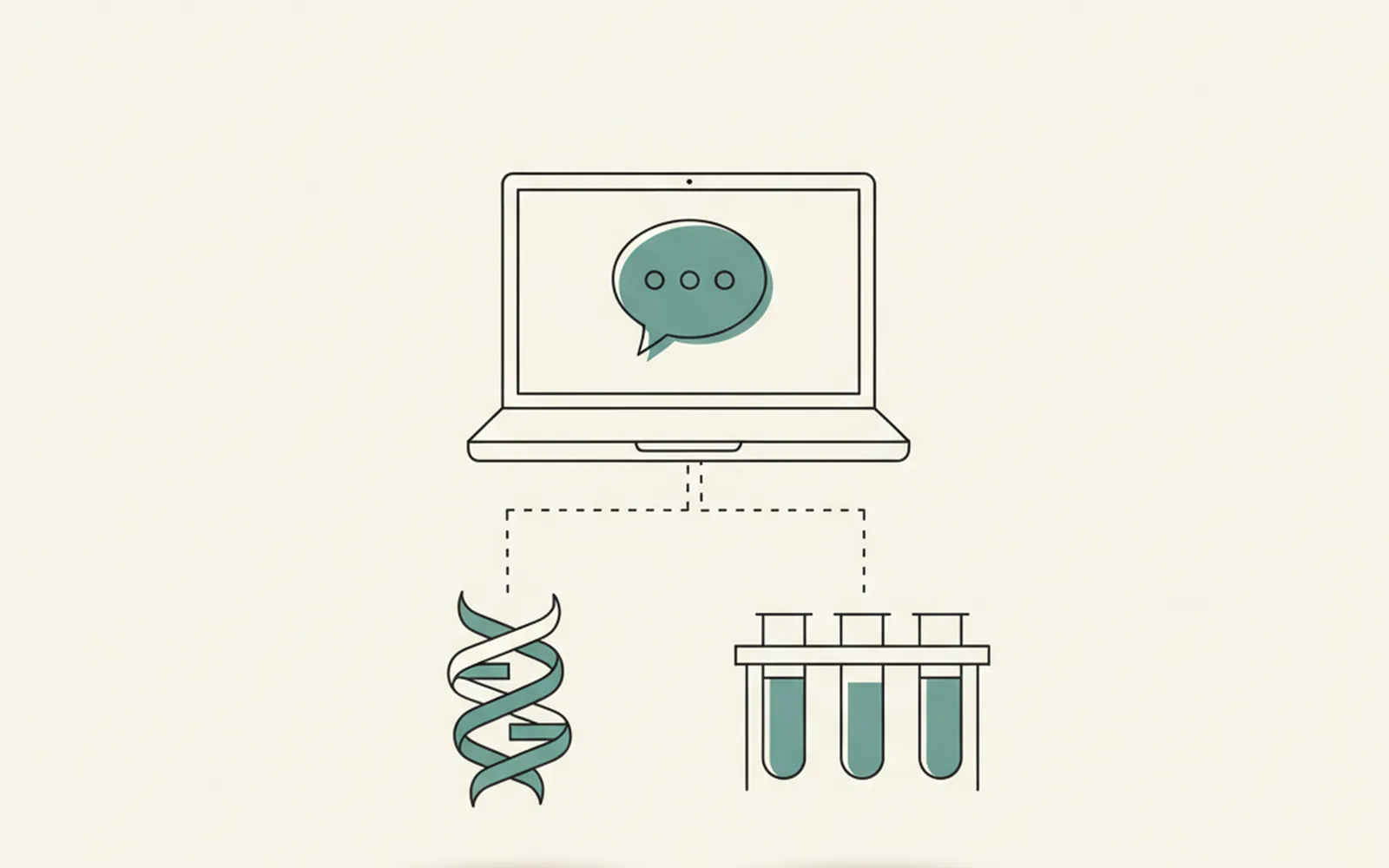
- General LLMs from Anthropic and OpenAI predicted and designed proteins, tasks long reserved for specialist tools such as AlphaFold.
- OpenAI's GPT-6.2 designed small binders for five targets; 35 of 322 tested in the lab worked, about an 11% hit rate, with a specialist tool still used for one step.
- The work is in blog posts and a preprint, not peer review, and OpenAI says some results may partly reflect memorized training data.
Over two weeks in November 2026, computational biologists watched something they did not expect: general-purpose language models answering questions about proteins that used to need dedicated software. It started with a 16 November blog post from Xinming Tu, of the AI-biology company Phylo, and Leo Chen, a computational biologist at Harvard Medical School, who reported that Anthropic's latest Claude models predicted obscure bacterial protein sequences better than not only other LLMs but also specialist "protein language models" trained only on sequence data.
On 24 November, Nature news reported the wider frenzy, and OpenAI announced that its own models had designed new proteins that behaved as expected when made and tested in a lab. For people who write scientific software, the headline capability matters less than the shape of the claim: a general model produced research output without the reproducible, version-controlled pipeline that normally sits behind such a result. Teams that want to turn that kind of model into something a lab can actually rely on usually end up building real software around it, and some bring in generative AI development services to wrap the model in validation, logging and data controls while the scientists keep ownership of the method.
That gap between a dazzling demo and a trustworthy tool is exactly the territory this site cares about. The same tension showed up in OpenAI's earlier survey of how scientists use AI for code, where checking the model's output was the single most common difficulty researchers reported.
What happened?
Two separate threads converged. The first was prediction: Tu and Chen found Claude could infer protein sequences and even perform a key step in structure prediction, work previously handled by tools like AlphaFold and ESMFold. The second was design. OpenAI's life-sciences team asked a model called GPT-6.2 to invent small proteins ("minibinders") that would stick to five biological targets, then made the designs in the lab to see whether they worked.
Both were published the way AI results increasingly are: as a blog post and a technical preprint, not a peer-reviewed paper. "In most cases, a specialist will always perform better than a generalist for a given task," Martin Pačesa, a structural biologist at the University of Zurich, told Nature. The surprise was how often the generalist was now in the same range.
What the numbers show
The design numbers are worth reading carefully, because they show both the promise and the asterisks:
- Binder design. Across five targets, 35 of 322 tested designs bound their target, a hit rate of about 10.9%. Respectable, but a specialist tool was still used to turn the model's shapes into genetic sequences.
- Some tasks beat specialists. On one structure-building benchmark the model scored 43.7% against a specialist tool's 27.8%.
- Others did not. Predicting full 3D protein structures was, in Nature's words, "far off" the specialist tools.
OpenAI was explicit about the limits, writing that its results "do not yet establish that our models can generate de novo minibinders end-to-end in a zero-shot setting without help from specialized models." In other words: impressive, not autonomous.
Understanding or memorization?
The open scientific question is whether the models have learned real biology or are recombining things they have seen. OpenAI itself noted that some sequence-inference results "may partly reflect memorization" of training data. That is not a footnote to research-software people; it is the whole game. A model that reproduces a known answer and a model that derives a new one look identical in a chat window and completely different in a pipeline.
This is the same failure mode we warn about in common errors in research code: an output that is correct for the wrong reason, which holds until the moment you rely on it for something genuinely new. The only way to tell the two apart is to test the model on held-out cases it cannot have memorized, and to confirm the winners experimentally, which is exactly what the lab step in the OpenAI work was for.
What it means for research code
Most labs will not be designing proteins next week. But the pattern, a general model producing plausible scientific output on demand, is arriving everywhere, and the discipline it requires is ordinary good software practice:
- Put the model inside a pipeline, not in place of one. The OpenAI result leaned on specialist tools and a wet-lab assay. The LLM was one component with code and checks around it, not the whole method.
- Validate on data the model has not seen. Memorization is invisible until you hold out a test set. Our guide to testing research code is a starting point for building that habit.
- Keep the prompt, the version and the output. A screenshot of a chat is not a reproducible record. Model name, version, prompt and seed belong in version control alongside the code.
- Review what the checks miss. Binding is not specificity, stability or biological activity, as OpenAI noted. A passing metric still needs human review.
The excitement is justified: general models are doing things this year that specialist software monopolized last year. The caution is too. Until the work is reproducible, held out and peer reviewed, a confident answer from a chat model is a hypothesis, not a result.
Questions about LLMs and protein biology
What happened?
In mid-November 2026, researchers found that general-purpose language models from Anthropic and OpenAI could predict protein sequences and structures. On 24 November OpenAI reported that GPT-6.2 designed small proteins that bound their targets in the lab, tasks usually left to specialist tools like AlphaFold.
How well did the OpenAI model do?
OpenAI asked GPT-6.2 to design small binders for five targets. Of 322 designs tested in the lab, 35 bound their target, a hit rate of about 10.9%. A specialist tool was still used to turn the designs into genetic sequences.
Do the models understand protein biology?
That is disputed. Some scientists think the models are learning real structure; OpenAI itself notes that some sequence results may partly reflect memorization of training data. The work is described in a blog post and preprint and has not been peer reviewed.
Why does this matter for research code?
It is a reminder that a general model can produce plausible scientific output without a reproducible pipeline behind it. Labs that want to use LLMs for real work still need version-controlled code, held-out validation and lab confirmation, not just a chat transcript.
Keep reading. More from the desk.

DeepMind's AI agents found cheaper quantum algorithms and proved them correct in Lean
Gemini agents found quantum algorithms up to 290x cheaper and proved each in Lean. What proof-checked AI search means for research code you cannot test.
DOE's Genesis Mission turns one: what a year of AI-for-science spending means for research code
A year into DOE's Genesis Mission: 297 projects, a shared AI platform and a push for AI-ready data. What it means for people who write research code.

OpenAI study: scientists say AI speeds up research code
OpenAI studied how 1,819 scientists used ChatGPT. Research code showed the largest self-reported time saving, and checking the output was the most common difficulty.