Snakemake vs Nextflow: choosing a workflow manager for research pipelines
How the two tools define a pipeline, where each fits on a cluster or in the cloud, what nf-core changes, and when a Makefile or targets is enough.
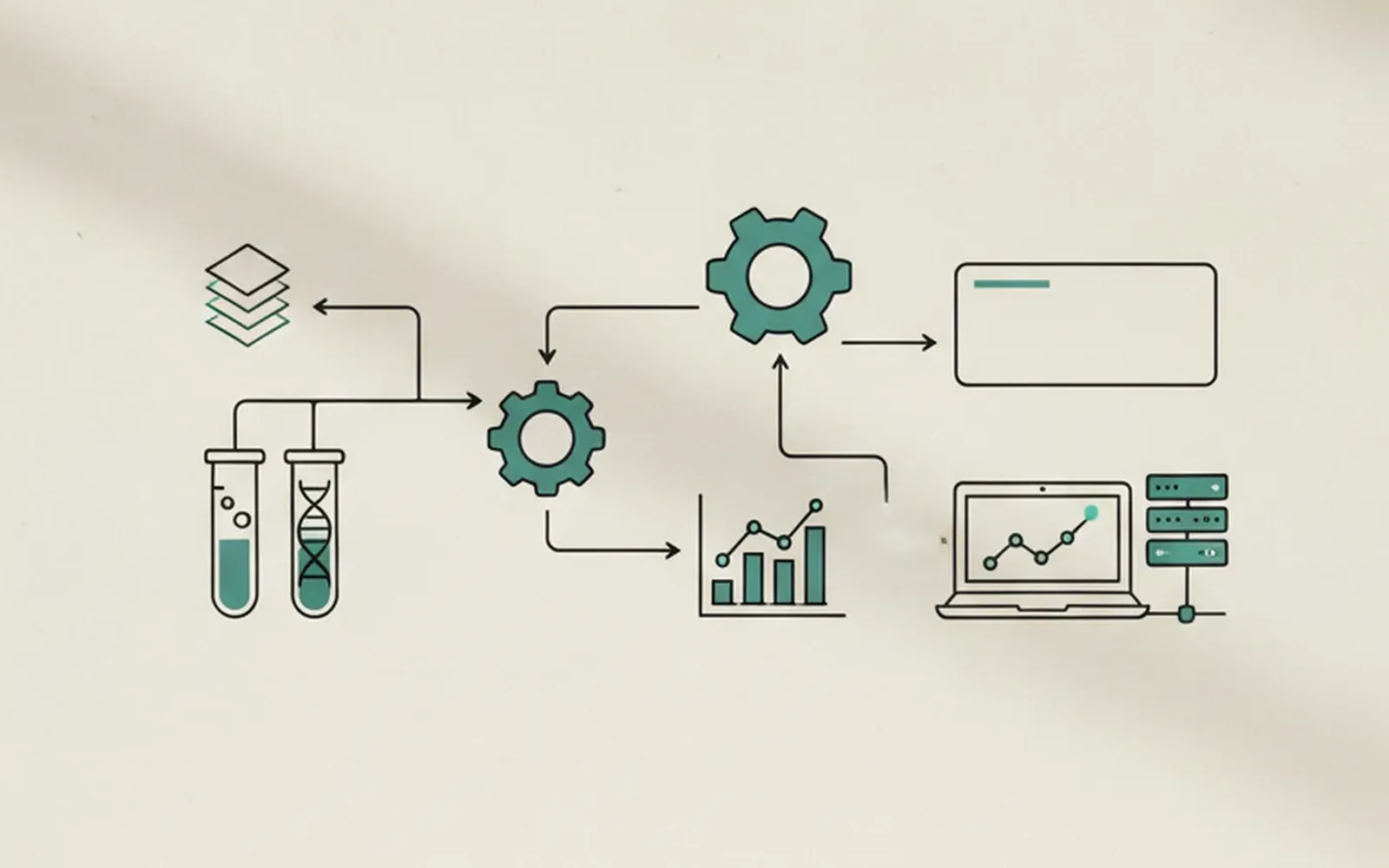
- Snakemake builds target files from rules written in Python; Nextflow streams data through processes in a Groovy-based language.
- If a maintained nf-core pipeline fits your analysis, run it rather than writing your own.
- Both run on Slurm and cloud batch services; choose by who maintains the pipeline, not by benchmarks.
- Pin tools, keep a tiny test dataset and tag releases, whichever tool you use.
Snakemake and Nextflow are the two workflow managers most research groups choose between, and both will run a reproducible pipeline on a laptop, a cluster or the cloud. In short: pick Snakemake if your group thinks in Python and writes its own pipelines, pick Nextflow if you want to reuse the curated nf-core pipelines or run at cloud scale, and pick neither if your analysis is a handful of steps you run twice a year.
A workflow manager is a program that runs the steps of an analysis in the right order, skips steps whose inputs have not changed, restarts after a crash from where it stopped, and sends each step to wherever the compute is. It replaces the run_all.sh script and the README line that says "then run step 4, but only if step 3 finished". Both tools are open source and free: Snakemake under the MIT licence, Nextflow under Apache 2.0.
Pipelines also change hands. Once a lab's pipeline turns into a service other people rely on, such as a hosted portal for collaborators or a reporting front end for a clinic, the extra work looks more like product engineering than analysis. Some groups then bring in a team that does life science software development for that outer layer, while the scientists keep ownership of the pipeline logic. Choosing a clear, well-documented workflow manager early makes that handover far easier.
What does a workflow manager do that a shell script does not?
A workflow manager tracks which outputs depend on which inputs, so it reruns only what changed and can resume after a failure. A shell script runs top to bottom every time and forgets everything when it stops.
- Dependency tracking. Each step declares its inputs and outputs; the tool works out the order and which steps can run in parallel.
- Resume and incremental runs. Change one parameter and only the affected steps run again. A crash at step 37 of 40 does not cost you steps 1 to 36.
- Portability. The same pipeline runs locally, on a Slurm cluster or on a cloud batch service by changing a profile, not the code.
- Software environments per step. Each step can declare its own Conda environment or container image, so tools with clashing dependencies coexist.
- Provenance. Run reports, logs and timing records show what ran, with which versions, and how long it took. Reviewers and your future self can check them.
If you already keep code under version control and environments pinned, as in our guides to version control for researchers and reproducible environments, a workflow manager is the next layer: it records how the pieces were run together.
How do Snakemake and Nextflow define a pipeline?
Snakemake works backwards from the files you want; Nextflow pushes data forwards through processes connected by channels. That one design choice explains most of the practical differences.
Snakemake: rules that make files
Snakemake was created by Johannes Köster and described in "Sustainable data analysis with Snakemake" (F1000Research, 2021). A Snakefile is a set of rules. Each rule says which output files it produces from which input files, using wildcards such as results/{sample}.bam. You ask for a final target, and Snakemake works out the chain of rules needed to build it, much like make.
The Snakefile is a superset of Python. You can import pandas, read a sample sheet and compute lists of targets in ordinary Python code, which is why Python-first groups find it easy to read and to review.
Nextflow: processes that pass data along channels
Nextflow was introduced in "Nextflow enables reproducible computational workflows" (Nature Biotechnology, 2017) and is now developed by Seqera. A pipeline is a set of processes; channels carry data between them, and a process runs whenever data arrive on its input channel. Its language is a domain-specific language built on Groovy, and it needs a Java runtime.
Since the DSL2 syntax, processes can be packaged as modules and subworkflows and shared between pipelines. That modularity is what the nf-core community builds on.
Snakemake vs Nextflow at a glance
The table below compares the two on the points research groups ask about most. Neither is better in general; each is better for a type of group.
| Question | Snakemake | Nextflow |
|---|---|---|
| Mental model | Rules that build target files (pull) | Processes fed by channels (push, dataflow) |
| Language | Python with extra syntax | Groovy-based DSL; needs Java |
| Ready-made pipelines | Snakemake Workflow Catalog and wrapper repository | nf-core: about 160 community pipelines with shared standards |
| Clusters (Slurm, LSF, PBS) | Yes, through executor plugins | Yes, built-in executors |
| Cloud batch and Kubernetes | Yes, through plugins | Yes, with AWS, Google Cloud and Azure batch executors |
| Containers and Conda | Per rule: Conda, Docker or Apptainer | Per process: Conda, Docker, Apptainer and others |
| Resume after failure | Reruns missing or outdated outputs | -resume reuses cached task results |
| Learning curve for a Python user | Gentle | Steeper: new language and dataflow thinking |
| Best fit | Small to mid-size groups writing custom analyses | Core facilities, consortia, cloud-scale and nf-core users |
Which has the better pipeline ecosystem?
Nextflow does, mainly because of nf-core. If a maintained nf-core pipeline already covers your analysis, running it is usually better than writing your own in either tool.
The nf-core pipeline list showed about 160 pipelines in November 2026, covering RNA-seq, variant calling, single-cell, metagenomics, proteomics and more. Each follows shared guidelines: tests on small datasets, containers for every tool, versioned releases and documentation. For a genomics lab that means less code to write and maintain, and a pipeline that reviewers may already know.
Snakemake's Workflow Catalog lists published Snakemake workflows on GitHub, and the wrapper repository offers reusable rules for common tools. It is useful but less uniform: quality and maintenance vary from workflow to workflow, so read the repository before you trust it.
Outside bioinformatics the gap narrows. Few ecology, imaging or social-science pipelines exist in nf-core, so you will write your own either way, and then the language your group already knows matters more.
How do they run on a cluster and in the cloud?
Both run on the common HPC schedulers and on cloud batch services; the difference is how much setup you need. In both tools the pipeline code stays the same and a profile or config file says where to run.
- Snakemake moved cluster and cloud support into executor plugins from version 8. Install the plugin for Slurm or your cloud, set it in a profile, and Snakemake submits each job for you.
- Nextflow ships executors for Slurm, SGE, PBS, LSF, Kubernetes and the AWS, Google Cloud and Azure batch services. Its work directory can sit on object storage such as S3, which suits teams that run mainly in the cloud.
On a shared cluster, check two things before the first big run: that containers run through Apptainer (most clusters do not allow Docker), and that the tool does not flood the scheduler with thousands of tiny jobs. Group small steps or use local execution for them. Our article on cloud computing for research code covers budgets and storage costs if you move off the cluster.
Which should your group choose?
Choose by who will maintain the pipeline and where it will run, not by benchmark charts. Speed differences mostly show up at very large task counts; in most lab pipelines the tools inside each step take most of the time.
Choose Snakemake when
- the people writing and maintaining the pipeline are comfortable in Python;
- the analysis is custom to your study and no maintained community pipeline fits;
- you run mainly on a laptop or a university cluster;
- readability for reviewers and new students is a priority.
Choose Nextflow when
- an nf-core pipeline already does what you need, or most of it;
- you run on cloud batch services or at the scale of a core facility;
- several groups or sites will run the same pipeline and need shared standards;
- you have, or can hire, someone willing to learn the DSL properly.
Whichever you choose, write the decision and the reason into the project README. A new postdoc who knows why the group picked one tool is far less likely to start a parallel pipeline in the other.
When do you need neither?
You may not need a workflow manager at all if the analysis has a few steps, runs on one machine and is rerun rarely. A tidy project layout and a single script with clear entry points can be enough.
- A Makefile covers short file-based pipelines and is installed everywhere.
- The targets package gives R users the same skip-what-is-up-to-date behaviour inside R, without leaving the language.
- CWL and WDL are workflow standards rather than single tools. Consider them when a funder, platform or consortium requires one, or when the pipeline must run on several engines.
- Galaxy suits groups that need a web interface for people who do not write code.
- Data-engineering schedulers such as Airflow or Prefect fit recurring, scheduled data jobs better than one-off scientific analyses.
The project structure in our guide to organising a research project folder works with all of these, and it makes a later move to a workflow manager painless.
How do you make a pipeline reviewable and reusable?
Treat the pipeline as research software in its own right: version it, test it on small data and document how to run it. The paper "Ten simple rules and a template for creating workflows-as-applications" gives a fuller list; these are the habits that matter most.
- Pin every tool. Give each rule or process an exact container tag or a locked Conda environment, never
latest. - Keep configuration out of code. Sample sheets, paths and parameters go in a config file, so another lab can run the pipeline without editing it.
- Ship a tiny test dataset. A run that finishes in minutes on a laptop lets reviewers and CI check the whole pipeline. Our guide to testing research code shows how to wire it into continuous integration.
- Tag releases. Cite the exact release used in a paper and archive it with a DOI, and say so in your code availability statement.
- Save the run report. Keep the execution report and logs for the runs behind published figures.
- Name a maintainer. A pipeline that ten people use and nobody owns breaks quietly; our piece on research software engineers covers who can take that role.
Can you move a pipeline from one tool to the other?
Yes, but there is no reliable automatic converter; it is a rewrite of the orchestration, not of the science. The scripts and tools each step calls stay the same, which is why keeping real logic in separate scripts rather than inline in the workflow file pays off.
Plan a migration step by step:
- Wrap the existing scripts unchanged.
- Port one stage at a time.
- Compare outputs from the old and new pipelines on the same test data before you switch.
- Record any differences you find and why they occur.
Questions about Snakemake and Nextflow
Is Snakemake or Nextflow better for bioinformatics?
Neither is better in general. Nextflow has the larger set of curated pipelines through nf-core, which matters if one fits your analysis. Snakemake is easier for Python-first groups writing custom pipelines. Choose by who will maintain the pipeline and where it will run.
Should I learn Snakemake or Nextflow first?
If you already write Python and build your own analyses, start with Snakemake. If your field relies on nf-core pipelines or your institute runs on cloud batch services, start with Nextflow, because you will read and adapt its pipelines anyway.
Is Nextflow faster than Snakemake?
For most lab pipelines the run time is set by the tools inside each step, not by the workflow manager. Differences appear with very large numbers of small tasks, where scheduling overhead adds up. Group tiny steps before blaming the tool.
Can Snakemake and Nextflow run on a Slurm cluster?
Yes. Snakemake uses an executor plugin for Slurm and other schedulers; Nextflow has a built-in Slurm executor. On most clusters you will run containers through Apptainer, because Docker is usually not allowed.
Can I convert a Snakemake pipeline to Nextflow automatically?
There is no reliable automatic converter. Moving between them means rewriting the orchestration while keeping the scripts and tools each step calls. Port one stage at a time and compare outputs on the same test data before switching.
Keep reading. More from the desk.
Reproducible environments for research code
Sharing your code is step one. Making sure it still runs on someone else's machine, next year, is step two. The tools are mature. The hard part is choosing the right level of effort.
How to organise a research project folder so others can follow it
A research project that only its author can navigate is hard to review, hard to hand over and hard to reproduce. A simple, consistent folder layout fixes most of that, and it takes an afternoon to set up.
Cloud computing for research: moving lab code to the cloud without surprises
When renting compute beats the campus cluster, and how to package code, keep data in object storage, cap the bill and keep cloud runs reproducible.